
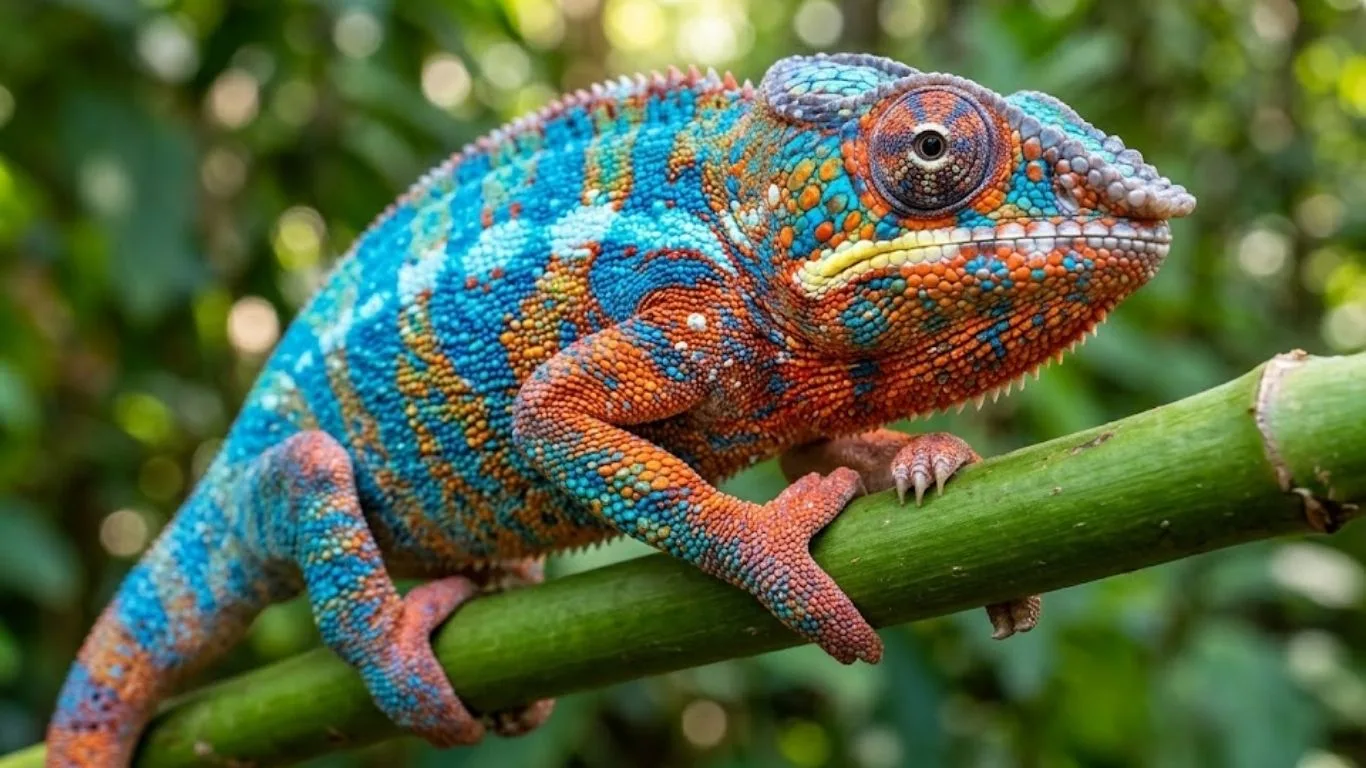
Chameleónovité: The Science of the True Chameleon Family
Most people think chameleons are just lizards that change color to hide. That belief is mostly wrong, and the real story is far more interesting. Chameleónovité is the Slovak and Czech term for the biological family Chamaeleonidae, the scientific grouping that contains all true chameleons on Earth.
As of May 2026, there are more than 234 recognized species in this family, and scientists are still discovering new ones. These reptiles do not change color primarily for camouflage. They do it to communicate, regulate body temperature, and signal mood.
The biology behind it involves nanoscale crystals in their skin that physically rearrange themselves, a mechanism so advanced that researchers at the University of Geneva published a landmark study in the journal Nature Communications describing it in detail.
This guide covers everything about chameleónovité: the meaning of the term, the biology of color change, the most important species, where they live, how they hunt, how they reproduce, the real conservation threats they face today, and what it takes to keep one responsibly in captivity.
What Does Chameleónovité Mean?
Chameleónovité is the Slovak and Czech word for the reptile family Chamaeleonidae, which contains all species of true chameleons. The term translates literally as “the chameleon family” and is used in scientific and educational writing across Central and Eastern Europe.
In English, the equivalent term is simply “chameleons” or “the family Chamaeleonidae.” The word does not name a single species. It refers to the entire evolutionary group, which currently holds over 234 described species.
The English word “chameleon” itself comes from the Greek words “khamai,” meaning “on the ground,” and “leon,” meaning lion, giving us the compound meaning of “ground lion,” a name that Aristotle used when describing these animals in antiquity.
The Full Classification of Chameleónovité
Chameleónovité sit within a precise position in the tree of life. They belong to the order Squamata, which includes all lizards and snakes. Within Squamata, they fall under the suborder Lacertilia, meaning lizards, and are placed in the family Chamaeleonidae.
The family divides into two subfamilies. The first is Chamaeleoninae, which contains the larger, more visually dramatic species most people picture when they think of chameleons. The second is Brookesiinae, which contains the dwarf and leaf chameleons, many of which are tiny enough to stand on a human thumbnail.
Three main genera account for almost all species found on Madagascar: Calumma, Furcifer, and Brookesia. On the African mainland, the genus Chamaeleo contains many of the most commonly known species, including the veiled chameleon and the flap-necked chameleon.
The Two Subfamilies at a Glance
| Feature | Chamaeleoninae | Brookesiinae |
| Size | Medium to very large | Miniature to small |
| Tail | Prehensile, used for gripping | Short, not strongly prehensile |
| Habitat | Trees and high shrubs | Leaf litter and low vegetation |
| Color change | Vivid and dramatic | Mostly subtle browns and greens |
| Key genera | Chamaeleo, Furcifer, Calumma | Brookesia, Rhampholeon |
| Primary range | Africa, Madagascar, Europe, Asia | Madagascar, sub-Saharan Africa |
Where Do Chameleónovité Live?
Chameleónovité are found across a surprisingly wide geographic range, but they are overwhelmingly concentrated in two regions. Africa and Madagascar together host the vast majority of all species.
Madagascar: The Global Center of Chameleon Diversity
Madagascar is the undisputed heart of chameleónovité diversity. Wildlife Madagascar reported in May 2025 that more than 234 species of chameleónovité exist globally, with almost half of them found on Madagascar alone.
Of those Malagasy species, 97 are endemic, meaning they exist nowhere else on Earth. This concentration makes Madagascar one of the most important places on the planet for reptile conservation.
The island’s extraordinary diversity comes from millions of years of isolated evolution. After Madagascar separated from mainland Africa roughly 88 million years ago, animals evolved in complete isolation. Chameleons adapted to fill ecological niches that other lizards occupy elsewhere, producing an astonishing range of sizes, colors, and behaviors.
Africa, Europe, and Asia
On the African mainland, chameleons are widespread across tropical forests, savannas, and even semi-arid regions. The common chameleon, Chamaeleo chamaeleon, is the species most people encounter in southern Europe. It lives in parts of Spain, Portugal, Greece, Malta, and Cyprus, making it one of the very few chameleónovité species found on the European continent.
Smaller populations exist in parts of the Arabian Peninsula, India, Sri Lanka, and Pakistan. These Asian and Middle Eastern populations represent the eastern edge of the family’s natural range.
The Science of Color Change: What Really Happens Inside Chameleónovité Skin
This is the question everyone wants answered, and most explanations get it wrong. Chameleónovité do not simply release pigment like an ink cartridge or expand dark spots to blend with a background. The mechanism is far more precise.
Two Layers of Iridophores
Professors Michel Milinkovitch and Dirk van der Marel at the University of Geneva led a research team that published their findings in Nature Communications, revealing that chameleónovité change color through the active tuning of a lattice of guanine nanocrystals inside specialized skin cells called iridophores.
These crystals do not produce pigment. Instead, they reflect specific wavelengths of light depending on how tightly or loosely they are packed together.
When a chameleon is calm and unstressed, the nanocrystals sit close together. They reflect shorter wavelengths such as blue and green.
When the animal becomes excited, whether through a territorial confrontation with another male or during courtship, the crystals spread apart. Wider spacing causes longer wavelengths to reflect, producing yellows, oranges, and reds. The result is a dramatic color shift that can happen within seconds.
The same study also found a second, deeper layer of iridophores with larger, less-ordered crystals. This deeper layer reflects near-infrared light and appears to serve a passive thermal protection function, helping chameleónovité manage their body temperature.
Why Color Change Is Mostly Communication, Not Camouflage
The persistent myth that chameleónovité change color to hide from predators is only partly true. The primary driver of color change is social communication. Males display vivid, complex patterns when they spot a rival male.
They show different patterns when approaching a female during mating. Stress produces dark, muted tones. A gravid (pregnant) female often develops a distinctive dark pattern with bright spots to signal that she is not receptive to mating. The color system is, in effect, a body-language broadcast system.
Some species, especially the smaller, ground-dwelling Brookesia leaf chameleons, do rely more heavily on passive camouflage through brown and grey tones that blend with leaf litter. But among the larger tree-dwelling species in Chamaeleoninae, communication is the dominant use of color.
The Most Important Species Within Chameleónovité
Veiled Chameleon (Chamaeleo calyptratus)
The veiled chameleon from Yemen and Saudi Arabia is the species most commonly kept as a pet worldwide. Males develop an impressive helmet-like structure called a casque on top of their head, which can reach several centimeters in height.
They grow up to 60 cm and display bold green, yellow, and brown patterns. Veiled chameleons are among the more adaptable chameleónovité in captivity, tolerating a slightly wider range of conditions than many other species, though this tolerance is often overstated by beginner pet guides.
Panther Chameleon (Furcifer pardalis)
The panther chameleon from Madagascar is arguably the most visually spectacular member of chameleónovité. Males from different regions of Madagascar display dramatically different color patterns. A male from Ambanja locality shows electric blues and reds.
A male from Nosy Be is predominantly blue-green. These geographic color variations, called locales, are so consistent that experts can identify a panther chameleon’s origin island region from its colors alone. The panther chameleon was the primary species used in the University of Geneva nanocrystal research.
Jackson’s Chameleon (Trioceros jacksonii)
Jackson’s chameleon is native to the highland forests of Kenya and Tanzania. Males carry three prominent horns on their heads, giving them a prehistoric appearance reminiscent of the Triceratops dinosaur.
Unlike most chameleónovité, Jackson’s chameleons give birth to live young rather than laying eggs, making them ovoviviparous. Females retain eggs internally until they hatch, then deliver fully formed juveniles. An introduced population established itself in Hawaii after escaping from the pet trade in the 1970s.
Brookesia micra and the World’s Smallest Chameleónovité
Brookesia micra, discovered in 2012 on the tiny island of Nosy Hara off the northern tip of Madagascar, was for years considered the world’s smallest reptile. Adult males measure less than 30 mm from snout to tail tip.
These miniature leaf chameleons spend their days foraging in leaf litter and climb to low branches at night to sleep. Their color change abilities are minimal compared to their larger relatives, but their tiny scale and delicate structure represent an extreme case of island miniaturization.
Parson’s Chameleon (Calumma parsonii)
Parson’s chameleon is the largest member of chameleónovité, reaching up to 68 cm in total length. It lives in the rainforests of eastern and northern Madagascar and is classified as Near Threatened on the IUCN Red List.
Legal trade in this species was halted in 1995 after CITES noted unsustainable collection for the exotic pet market. These animals are extremely slow to mature and reproduce, which makes them highly vulnerable to population pressure.
Read also: Schedow Guide: Master AI-Driven Productivity in 2026
How Chameleónovité Hunt: The Ballistic Tongue
The hunting mechanism of chameleónovité is one of the most extraordinary physical adaptations in the entire animal kingdom. A chameleon can sit completely still for long periods, relying on its independently rotating eyes to scan a nearly 360-degree visual field. Each eye moves independently, meaning the animal can watch one direction with one eye while tracking another target with the other.
When prey is spotted, the chameleon focuses both eyes forward, achieving binocular vision and precise depth perception. Then it fires its tongue.
The tongue of a chameleónovité typically extends to between 1.5 and 2 times the animal’s body length. The launch takes roughly 0.07 seconds. The tip of the tongue is covered with a thick, sticky mucus pad that adheres to insects on contact.
The muscle system behind the launch works like a coiled spring, storing elastic energy in a structure called the accelerator muscle before releasing it in an explosive contraction.
Chameleónovité eat insects primarily: crickets, locusts, moths, flies, and beetles, depending on what is available in their habitat. Larger species occasionally take small vertebrates, including lizards and small birds.
Chameleónovité Reproduction: Eggs, Live Birth, and Lifespan
Most chameleónovité are oviparous, meaning they lay eggs. After mating, the female descends from her tree, digs a burrow in soft soil, and deposits a clutch of eggs ranging from as few as 2 in small Brookesia species to over 80 in the veiled chameleon.
She then covers the eggs, returns to the trees, and plays no further role in raising offspring. Eggs incubate underground for anywhere from 4 months to over 24 months, depending on the species and soil temperature.
A small number of species are ovoviviparous, retaining the eggs internally until they hatch. Jackson’s chameleons, Trioceros ellioti, and a few others follow this strategy, which is better suited to cool montane environments where ground temperatures would be too cold for successful egg incubation.
Chameleónovité generally have shorter lifespans than most lizards of comparable size. Many species live only 2 to 5 years in the wild. Parson’s chameleon is a notable exception, with wild individuals potentially surviving 10 years or more.
The One Fact About Chameleónovité That Most Articles Get Wrong
Every article about chameleónovité covers color change. Almost none of them explain the male-versus-female split clearly, and it is genuinely important.
In most chameleónovité species, the vivid color change that everyone recognizes is primarily a male behavior. Females of many species are duller by comparison, often maintaining green or brown tones through most of their adult lives.
The one time female coloration becomes intensely important is during pregnancy. Gravid females develop bold, species-specific patterns that actively repel unwanted male attention. A female panther chameleon carrying eggs turns dark with bright orange spots. Any male who misreads this signal risks being physically rejected.
Think about a hobbyist in Prague who buys what the seller calls a “colorful panther chameleon” and receives a young female. She stays dull green for months. The owner thinks something is wrong. Nothing is wrong.
She is a healthy female chameleónovité, and her color tells a different story than the males in the YouTube videos. Understanding this distinction prevents a lot of confusion and a lot of unnecessary vet visits.
Conservation Threats Facing Chameleónovité in 2026
The conservation picture for chameleónovité is genuinely worrying. A May 2025 report from Fauna and Flora International documented that the Belalanda chameleon, Furcifer belalandaensis, had not been recorded in its native habitat since November 2024, before a small population was finally rediscovered in a degraded ecosystem in southwestern Madagascar. The IUCN lists this species as Critically Endangered. It has one of the smallest known distributions of any land vertebrate on Earth.
The Belalanda chameleon’s situation is extreme, but it illustrates the pressures facing chameleónovité more broadly.
Deforestation
Madagascar has lost over 90 percent of its original forest cover, primarily to slash-and-burn agriculture known locally as tavy, logging, and charcoal production. Since most Malagasy chameleónovité species have very small natural ranges and cannot survive outside forest habitat, deforestation is the single biggest driver of species decline.
Illegal Wildlife Trade
All chameleónovité are protected under CITES, the Convention on International Trade in Endangered Species. Most species fall under Appendix II, which allows regulated legal trade.
A handful of highly threatened species fall under Appendix I, which bans commercial trade entirely. Despite these protections, illegal collection for the exotic pet trade remains a persistent problem, particularly in Madagascar.
Climate Change
Rising temperatures and altered rainfall patterns threaten to shift the habitat ranges that chameleónovité species evolved to occupy. Because many species are tied to very specific elevational and geographic zones, even moderate climate shifts can push local conditions outside survivable parameters.
The first International Chameleon Day, organized by Wildlife Madagascar in May 2024, specifically highlighted climate vulnerability as an emerging threat alongside habitat loss.
Also read: Koriandri: The Complete 2026 Guide to Coriander & Cilantro
Chameleónovité as Pets: What You Need to Know Before Buying
Chameleónovité are among the most demanding reptiles in the pet trade. They are not beginner animals, and they are not suited for owners who want a reptile they can handle regularly.
Why Chameleónovité Stress Easily
Chameleónovité are solitary animals that evolved to live alone in trees. Physical handling by humans triggers genuine physiological stress responses. Repeated or prolonged handling in captivity weakens immune function over time. Many chameleónovité kept by beginners die within their first year, not from disease but from chronic stress. A responsible keeper handles their animal only when necessary for health checks or veterinary care.
Basic Husbandry Requirements
- Screen enclosures, not glass tanks, because chameleónovité need constant airflow and cannot navigate out through glass.
- UVB lighting is essential for vitamin D3 synthesis and calcium metabolism. Without it, metabolic bone disease develops rapidly.
- A temperature gradient from around 24 to 32 degrees Celsius during the day, with a cooler night drop.
- Live gut-loaded insects dusted with calcium and vitamin supplements.
- Dripping water rather than standing water bowls. Most chameleónovité will not drink from a still water source.
The Best Species for Experienced Beginners
Veiled chameleons and panther chameleons are the two species most commonly recommended for first-time chameleónovité keepers, specifically because they are captive-bred in relatively large numbers, have more established husbandry knowledge, and are slightly more forgiving of minor care errors than more delicate species. Jackson’s chameleons are the third common recommendation, particularly in climates that allow outdoor enclosures.
What Is Chameleónovité? A Direct Answer
Chameleónovité is the Slovak and Czech scientific term for the reptile family Chamaeleonidae, which contains all true chameleons. This family includes over 234 recognized species of highly specialized, mainly tree-dwelling lizards found across Africa, Madagascar, parts of Europe, the Middle East, and Asia.
They are defined by zygodactyl gripping feet, prehensile tails, independently moving eyes, ballistic tongues, and skin that changes color through the rearrangement of guanine nanocrystals inside cells called iridophores.
Chameleónovité and the World of Science: Key Researchers
The scientific study of chameleónovité has been shaped by several important figures. Professor Michel Milinkovitch at the University of Geneva led the team whose 2015 Nature Communications paper fundamentally changed how scientists understand chameleon color change. His laboratory at UNIGE continues to research the biophysics of chameleónovité skin and the genetics underlying their color patterns.
Hajaniaina Rasoloarison, a Malagasy doctoral student in conservation biology supported by the Conservation Leadership Program, made international news in May 2025 when her team relocated the Belalanda chameleon in degraded forest outside its previously known range. Her work highlights the critical role of local Malagasy researchers in protecting chameleónovité biodiversity on their home island.
The organization Madagasikara Voakajy, a Malagasy conservation association, has focused specifically on Calumma tarzan, a Critically Endangered species first described scientifically in 2009 and endemic to a small area of eastern Madagascar. Their work has been a model for integrating local community engagement with scientific monitoring in chameleónovité conservation.
Read more: Dado à: Meaning, Grammar, and Usage Guide in Portuguese
Conclusion
Chameleónovité are not just color-changing lizards. They are one of evolution’s most extraordinary experiments: animals with binocular vision, nanocrystal skin, ballistic tongues, and gripping feet that can lock onto a branch in a storm.
Over 234 species fill ecological niches from the rainforests of eastern Madagascar to the scrublands of southern Spain. Many of them face serious threats right now in May 2026, from deforestation and illegal trade to climate shifts that narrow their survivable range.
Understanding chameleónovité, their biology, their diversity, and the pressures they face, is the first step toward caring about their survival. These animals have been capturing human imagination since Aristotle. They deserve more than a reputation as color-change tricks.
For broader context on the evolutionary biology and taxonomy of lizards and the order Squamata to which chameleónovité belong, the Wikipedia entry on Chamaeleonidae provides a comprehensive scientific overview.
Frequently Asked Questions About Chameleónovité
What does chameleónovité mean in English?
Chameleónovité is the Slovak and Czech term for the biological family Chamaeleonidae, which contains all true chameleons. In English, it simply means “the chameleon family.” It refers to the entire group of over 234 chameleon species, not one single animal.
How many species of chameleónovité exist?
As of May 2026, Wildlife Madagascar reports more than 234 recognized chameleon species. New species are still being described regularly, particularly small Brookesia leaf chameleons in Madagascar.
Why do chameleónovité really change color?
The primary reason is communication, not camouflage. Males display color to compete with rivals and attract mates. Females signal reproductive status through color. Both sexes use color to signal stress or submission. Passive camouflage plays a secondary role, especially in ground-dwelling species.
How does the color change actually work physically?
Research from the University of Geneva published in Nature Communications showed that chameleónovité change color by rearranging guanine nanocrystals inside skin cells called iridophores. When crystals pack tightly, they reflect blue and green wavelengths. When they spread apart, they reflect yellow, orange, and red.
Are chameleónovité good pets?
For experienced reptile keepers, yes. For beginners, generally no. They are solitary, stress easily from handling, require specific lighting and feeding conditions, and have husbandry needs that many first-time owners underestimate. Mortality rates in novice care are high.
Where do chameleónovité live in the wild?
The highest diversity is in Madagascar and sub-Saharan Africa. Smaller populations live in parts of Spain, Portugal, Greece, the Middle East, India, and Sri Lanka. Nearly half of all species exist only on Madagascar.
Are chameleónovité endangered?
Many species are threatened. The IUCN Red List classifies over 40 percent of chameleónovité species as vulnerable, endangered, or critically endangered. Major threats include deforestation in Madagascar, illegal wildlife collection, and climate change altering their forest habitat.
What do chameleónovité eat?
The majority are insectivores, feeding on crickets, locusts, moths, and other insects. Larger species will occasionally eat small lizards or birds. In captivity, a varied diet of gut-loaded insects dusted with calcium and vitamin supplements is essential.
How long do chameleónovité live?
Most species live between 2 and 5 years in the wild. Larger species like Parson’s chameleon can live 10 years or more. In captivity, lifespan varies enormously depending on the quality of care, with well-kept veiled chameleons often reaching 6 to 8 years.
What is the smallest chameleónovité species?
Brookesia micra from Madagascar was long considered the world’s smallest reptile, with adult males under 30 mm in total length. Subsequent discoveries have identified similarly miniaturized Brookesia species, and research continues to find new miniature chameleónovité in Madagascar’s remaining forests.