Tech Giants Envision Future Beyond Smartphones: 2026 Guide
In May 2026, Counterpoint Research confirmed what many suspected: global smartphone shipments are facing a 12% year-on-year decline, the sharpest drop on record. That number is not just a supply problem. It is a signal.
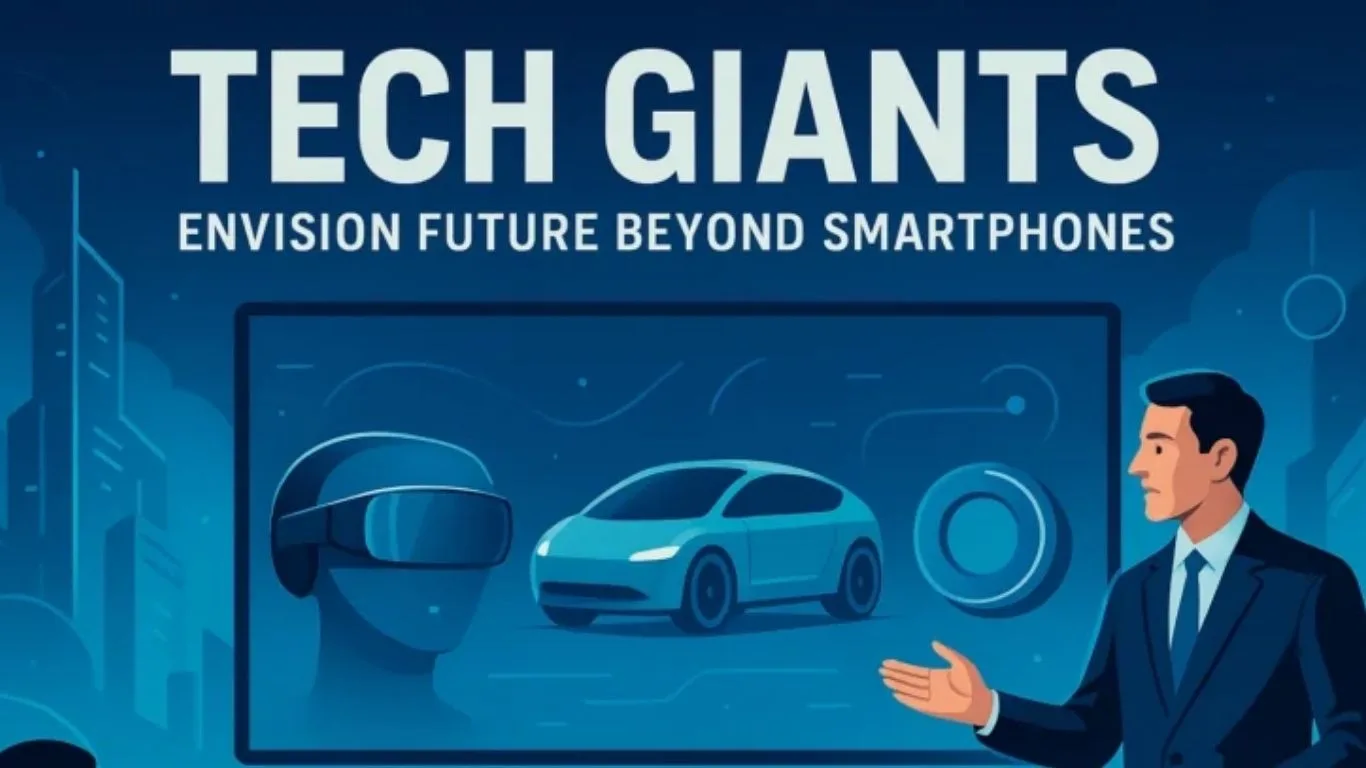
The device that ran the world for 15 years is losing its grip, and the companies that built their empires on it are already building something new. Tech giants envision a future beyond smartphones, and the race to own the next computing platform has never been more intense or more real.
This article breaks down exactly what Apple, Google, Meta, and Samsung are building to replace the smartphone, why the timing makes sense right now, what the transition will actually feel like for everyday users, and which technologies are closest to becoming part of your daily life. If you want to understand where personal computing is going in the next decade, this is the article to read.
Why Tech Giants Are Moving Beyond Smartphones Right Now
The shift is not happening because companies suddenly got ambitious. It is happening because the numbers forced their hand.
The Smartphone Market Is Contracting Fast
According to the International Data Corporation (IDC), in a March 2026 report, global smartphone shipments are projected to plummet 13% year-over-year in 2026, a reduction of approximately 160 million units, bringing totals down to around 1.1 billion. Even Q1 2026 showed shipments already falling 4.1% year-on-year.
Counterpoint Research puts the decline at 12%, calling it the sharpest on record. Memory chip shortages driven by AI data center demand are pushing component prices up, squeezing consumer budgets. The low-end market is hit hardest, but no brand escapes the pressure.
This is not a typical market cycle. It represents a structural shift in what people want from their devices.
Upgrade Cycles Have Stretched to 3.5 Years
According to a February 2026 update from SQ Magazine, the average global smartphone replacement cycle has extended significantly to 3.5 years. Consumers are not replacing phones because their current device still works fine. The difference between a 2022 phone and a 2025 phone is not compelling enough to spend $800 to $1,200 on an upgrade.
When consumers stop upgrading, revenue growth must come from somewhere else. That somewhere else is the post-smartphone platform.
The Innovation Story Has Moved On
Think about the energy around the first iPhone launch in 2007. Then the App Store in 2008. Then 4G enables streaming. Then the camera wars. Each wave created genuine excitement and billions in new spending. The current wave of phone releases, thinner bezels, and slightly improved cameras, generates nothing close to that response.
The innovation story that investors, developers, and consumers care about is now happening in AI, augmented reality, and wearable computing. Tech giants envision a future beyond smartphones precisely because that is where the growth narrative has shifted.
What Tech Giants Are Actually Building: Company by Company
Apple’s Bet: Spatial Computing and Smart Glasses
Apple has spent more than a decade quietly preparing for a world where the iPhone is not the center of the ecosystem. Vision Pro was the first public signal, but the more significant move is what comes next.
Bloomberg’s Mark Gurman reported in early 2026 that Apple is testing four distinct frame designs for its first smart glasses, codenamed N50. Production may start as early as December 2026, with a public release targeted for 2027. The device pairs with an iPhone via Bluetooth and uses an upgraded version of Siri, expected with iOS 27, to process queries through built-in speakers. Apple’s computer vision camera will enable features similar to its Visual Intelligence capability on iPhone, allowing users to look at objects, text, or locations and receive AI responses instantly.
Apple’s FY2025 revenue hit $416.2 billion, with iPhone accounting for $209.6 billion. The wearables segment already generates billions. Apple is in no rush to kill the iPhone. But it is absolutely positioning the next computing platform, and it has both the financial muscle and the installed base of 1.5 billion iPhones to make the transition on its own terms.
What Apple’s Spatial Computing Vision Means in Practice
Spatial computing is the term Apple uses to describe technology that blends digital content with the physical world. Instead of tapping a flat screen, you interact with life-sized digital objects around you using your eyes, hands, and voice.
Vision Pro showed the concept. The N50 glasses bring it into daily life at a price and weight that makes consistent use possible. This is the transition Apple is engineering.
Meta’s Strategy: Own the Face Before Anyone Else Can
Mark Zuckerberg has been more direct than any other tech executive about what comes next. He believes smart glasses will be the primary computing device of the future. And in May 2026, Meta has the strongest evidence that this is already happening.
Meta sold over 7 million Ray-Ban smart glasses in 2025 and currently controls 72.2% of the global smart glasses market, according to IDC’s March 2026 tracker. Ray-Ban Meta hardware revenue hit an estimated $2.15 billion in 2025, surpassing Quest headset revenue for the first time. Meta’s EssilorLuxottica partnership, which now includes Oakley-branded performance frames alongside the Ray-Ban line, solved the problem that killed Google Glass in 2013: nobody wants to look like a tech experiment.
The 2026 Meta lineup expanded to include Oakley sport frames and AR-capable models. The strategic play is simple: get the hardware on faces now, build trust, then layer in holographic display capabilities as the technology matures.
Meta has poured tens of billions into Reality Labs to get here. Those losses tested investor patience for years. But with 7 million units sold and 72% market dominance, Zuckerberg’s bet is starting to look prescient.
The Privacy Problem Meta Has Not Solved
Meta’s lead carries a real liability. A Swedish media investigation found that Meta subcontractors in Kenya were data-labeling videos captured through Ray-Ban glasses, including footage of private spaces. Researchers confirmed that the recording indicator LED can be disabled with tape. A reported “Name Tag” feature, which would identify people in the glasses’ camera view, triggered a formal investigation request to the FTC.
For a company with Meta’s history on privacy, these issues are not minor footnotes. They are structural risks that Apple, with its privacy-first brand positioning, is preparing to exploit directly.
Google’s Approach: The Open Ecosystem Play
Google is not trying to win by building the most beautiful device. It is trying to own the platform layer. Its Android XR ecosystem, built in partnership with Samsung and Qualcomm, aims to do for smart glasses what Android did for smartphones: create an open platform where hundreds of manufacturers can compete while Google controls the AI, search, and services layer underneath.
Google invested $5.7 billion in AR and AI development. Its first consumer Android XR glasses are targeting a $500 to $700 price point for basic features in 2025 to 2026, with premium AR options hitting $1,000 to $1,500 by 2027.
The broader XR category is projected to compound at 26.5% annually through 2030, according to IDC’s March 2026 report. Google is betting that owning the open platform in that growth wave creates more durable value than competing on hardware.
Samsung’s Ecosystem Diversification
Samsung is running the most cautious strategy of the four major players, which makes sense given its position as the world’s largest smartphone maker with 20% market share. Its Galaxy XR device launched as a mixed reality headset in early 2026, described by reviewers as a cheaper and lighter Vision Pro alternative. It runs Android XR and targets the premium productivity market.
Samsung’s deeper long-term play connects robotics, wearable health sensors, smart home devices, and AR displays into a single ecosystem. The Galaxy Watch platform, Galaxy Buds, and smart home products are already nodes in this network. The goal is a world where the smartphone is just one device among many, not the device everything else depends on.
Read more: Groovy Server Pages (GSP) Guide: Grails 7 Updates for 2026
What Is Replacing Smartphones? The Real Candidates in 2026
Smart Glasses: The Closest Thing to a Smartphone Replacement
This is where the evidence is clearest. According to IDC data from March 2026, VR and MR headset shipments fell 42.8% in 2025 while the rest of the XR market grew 211.2%. Consumers chose lighter, AI-enabled smart glasses over bulky headsets.
The global smart glasses market was valued at $2.46 billion in 2025 and is projected to reach $3.16 billion in 2026. Smart glasses shipments surged 139% year-over-year in the second half of 2025. By 2033, the market is forecast to hit $14.38 billion, growing at a compound annual growth rate of 24.2%.
The BoF-McKinsey State of Fashion 2026 report projected the smart eyewear category could exceed $30 billion by 2030. This is not a niche market. It is becoming a mainstream one.
AI Assistants Without Screens: Ambient Computing
The second major replacement candidate for the smartphone interface is AI that works without any screen at all. The idea is ambient computing: intelligence that surrounds you and responds to you, without requiring you to pick up a device.
Amazon Alexa, Apple’s upgraded Siri, and Google Gemini are all moving toward proactive, context-aware assistance. Instead of waiting for you to ask a question, these systems anticipate what you need based on your location, calendar, communication history, and behavior patterns.
A developer in Lahore in May 2026, checking into a morning meeting no longer needs to open a calendar app, navigate to the event, and find the dial-in link. The AI assistant surfaces it automatically 90 seconds before the meeting starts, through a voice prompt in the smartwatch or glasses. That is ambient computing doing the work the smartphone used to do.
Neural Interfaces: The Long Game
Neuralink, the brain-computer interface company founded by Elon Musk, successfully implanted its first human device in January 2024. In 2026, its second-generation device is being tested with expanded capabilities, including cursor control, text input, and eventually direct communication between devices and the human nervous system.
Neural interfaces are not a near-term replacement for smartphones. They are a decade-plus technology for most consumers. But for people with neurological conditions, they are already changing lives. And for tech companies thinking about the 20-year horizon, they represent the most radical shift in human-computer interaction ever attempted.
The One Thing Every Other Article Gets Wrong About the Post-Smartphone Era
Every competitor article covering tech giants envision future beyond smartphones makes the same assumption: the smartphone will be replaced suddenly, the way it replaced feature phones.
That is not what is happening. And understanding why it is not happening is the most important insight in this entire topic.
Feature phones were replaced fast because smartphones were objectively better at every function that mattered. Better communication, better music, better maps, better cameras. The upgrade decision was obvious.
Smart glasses, spatial computing headsets, and ambient AI are not obviously better than smartphones at everything yet. They are better at some things: hands-free interaction, natural language processing, navigating physical spaces, maintaining social awareness while receiving digital information. But they are worse at others: precise text input, high-resolution visual content creation, and the sheer convenience of a device that fits in a pocket.
What is actually happening is a platform expansion, not a platform replacement. The smartphone remains in your pocket. The glasses sit on your face. The AI assistant runs across both. The computing experience becomes distributed across multiple devices working together, with the smartphone gradually becoming less central to that network as the other nodes become more capable.
Tech companies understand this. That is why none of them are saying “we are killing the smartphone.” They are saying “we are building the next platform,” because they know both will coexist, with the balance of power shifting slowly over 5 to 10 years.
Tech Giants Beyond Smartphones: Who Is Winning in May 2026?
| Company | Key Product | Market Position | Biggest Strength | Biggest Risk |
| Meta | Ray-Ban glasses + Oakley frames | 72.2% smart glasses share | Already on millions of faces | Privacy credibility gap |
| Apple | N50 glasses (2027), Vision Pro | Leading spatial computing brand | Ecosystem lock-in, privacy trust | Late to smart glasses market |
| Android XR platform | Open ecosystem leader | Developer reach, AI strength | No breakout hardware hit yet | |
| Samsung | Galaxy XR headset | Premium XR hardware | Device diversity, scale | Dependent on Google’s platform |
| Microsoft | HoloLens, Azure AI | Enterprise leader | B2B dominance | Weak consumer presence |
| OpenAI | Ambient AI software | Platform-agnostic | Runs on everything | No hardware of its own |
The Privacy Reckoning That Could Slow Everything Down
Tech giants envision a future beyond smartphones, but regulators in 2026 are paying very close attention to what that future looks like for personal privacy.
Smart glasses with cameras represent the most significant expansion of surveillance capability in consumer technology history. Unlike a phone that you choose to point at something, glasses that continuously record everything in your field of vision create an always-on data collection system attached to your face.
The EU AI Act, which took effect in 2025, classifies real-time biometric identification in public spaces as a high-risk AI application. European regulators have already signaled that camera-equipped smart glasses will face scrutiny. GDPR compliance for continuous location and visual data collection creates legal complexity that no company has fully resolved.
The companies moving fastest, Meta in particular, have the worst track records on privacy. The companies with the best privacy reputations, Apple primarily, are moving more slowly. That gap between speed and trust is one of the central tensions shaping how the post-smartphone transition plays out.
What the Future Beyond Smartphones Actually Feels Like Day to Day
Abstract technology trends are useful for investors. But most people reading this want to know: what does my life actually look like in 2030?
Here is a realistic picture based on what is already in development today.
You wake up and your AI assistant has already reviewed your schedule, flagged a traffic delay on your usual commute route, and queued three urgent messages that arrived overnight. It tells you this through your bedside speaker or earbuds. You do not pick up a phone.
You put on your glasses before leaving the house. They show a subtle navigation overlay as you walk to your car or to the train. They translate the conversation you overhear in a language you do not speak. They surface the name of the person you are about to meet, with context from your last three interactions, before you even reach out to shake their hand.
At your desk, you open a spatial computing display if you are doing creative or analytical work. Multiple virtual screens float in front of you. No physical monitors required.
Your phone is still in your pocket. You use it when you need a camera with precise control, when you want to type something long, or when you need a private screen. But you check it less often. Maybe once or twice an hour rather than 96 times a day, which is the current global average according to research cited by tech analysts in 2025.
That is the future tech giants are building. Not a world without smartphones. A world where you barely notice you have one.
Frequently Asked Questions About the Future Beyond Smartphones
Will smartphones actually disappear?
No. Smartphones will not disappear. They will become less central to daily computing over the next decade. Just as desktop computers still exist but stopped being the primary device for most people around 2012, smartphones will remain useful but gradually share the role of “main device” with glasses, wearables, and ambient AI systems.
When will smart glasses replace smartphones?
Mainstream replacement, where more people use smart glasses as their primary device than smartphones, is unlikely before 2032 to 2035. Early adoption is already happening in 2026, with Meta Ray-Ban glasses selling 7 million units in 2025. But mass consumer adoption at smartphone scale requires lower prices, all-day battery life, and stronger use case clarity.
What is ambient computing and how does it work?
Ambient computing means technology that works in the background without requiring you to actively interact with a screen. Your AI assistant monitors your calendar, location, communications, and habits, then delivers information and completes tasks automatically. You interact through voice, gestures, or brief glances at a wearable display rather than through constant tapping.
Why is Apple entering the smart glasses market so late?
Apple intentionally waited. The company watched Google Glass fail in 2013, studied Meta’s early Ray-Ban generations, and is now entering with a clearer consumer use case and a privacy architecture its competitors cannot match. Apple’s N50 device is codenamed internally and targets a 2027 release, competing in a market that Meta has already proven has real consumer demand.
Is Meta’s dominance in smart glasses secure?
Not completely. Meta holds 72.2% of the smart glasses market in 2026, but faces serious privacy liabilities and incoming competition from Apple, Google, and Chinese manufacturers. Its lead is real but not unassailable. The inflection point comes around 2027 when display-enabled glasses begin to outsell audio-only models, shifting the battlefield toward capabilities where Apple and Google are stronger.
What role does AI play in the future beyond smartphones?
AI is the entire engine of the post-smartphone transition. Smart glasses, ambient assistants, and spatial computing headsets are only useful because AI makes them proactive, context-aware, and genuinely helpful without constant manual input. Without the current generation of large language models and on-device AI processing, none of these devices would offer enough value to compete with the smartphone.
How will this affect app developers and the app economy?
The App Store and Google Play model faces disruption. When the primary computing surface moves from a touchscreen to glasses and ambient AI, app discovery, design, and monetization all change. Voice-first and AI-agent interfaces do not naturally favor the same kind of app browsing and icon-tapping that smartphones enabled. Developers building for the next platform need to think in terms of contextual triggers and AI integration rather than traditional app UI.
What is the Google Android XR ecosystem?
Android XR is Google’s operating system for extended reality devices, including smart glasses and mixed reality headsets. Built in partnership with Samsung and Qualcomm, it aims to be the open platform for non-Apple smart glasses the same way Android is the open platform for non-Apple smartphones. Google’s first consumer-facing Android XR glasses are targeted for a $500 to $700 launch price.
How does Neuralink fit into the future beyond smartphones?
Neuralink’s brain-computer interface technology represents the most extreme version of post-smartphone interaction: direct neural control of devices. Its first commercial device launched in 2024. In 2026, second-generation implants enable text and cursor control. Mass consumer adoption is likely decades away, but Neuralink establishes the theoretical endpoint of human-computer interaction that all other interface technologies are moving toward.
Is the post-smartphone shift good or bad for consumers?
Both. The benefits are real: less time staring at a screen, more natural information access, better hands-free workflows, and richer human interaction supported rather than replaced by technology. The risks are also real: always-on cameras create privacy exposure, data collection becomes harder to limit, and digital inequality grows between people who can afford premium wearables and those who cannot.
Conclusion
The data in May 2026 is unambiguous. Global smartphone shipments are falling at record rates, the average replacement cycle has stretched to 3.5 years, and the companies building our digital future are pouring billions into glasses, headsets, ambient AI, and neural interfaces instead of new phone designs.
Tech giants envision a future beyond smartphones not because phones are broken, but because the next platform offers far more growth, more lock-in, and more influence over how humans interact with information. Meta is already on 7 million faces. Apple is months from entering the market. Google is building the open platform for everyone else to run on.
The smartphone will not disappear. But the center of gravity of your digital life is moving, quietly and steadily, off the screen in your pocket and onto the world around you.
The companies that own that new layer will be the most powerful technology companies of the 2030s. That is exactly why every major tech giant is racing to build it right now.
For a deeper grounding in the technology underlying this shift, the Augmented reality article on Wikipedia provides a thorough overview of how spatial computing and AR systems actually work.